

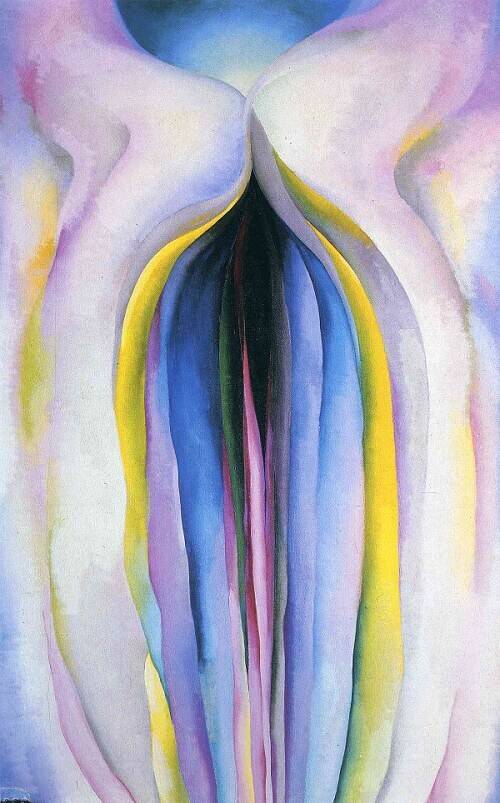
Grey Lines with Black, Blue and Yellow, c. 1923. Georgia O'Keeffe
Georgia O’Keeffe is often associated with the return of female imagery in modern art. Her large-scale flower paintings, created during the 1920s and 1930s, have frequently been interpreted as evocations of the vulva and female sexuality. These readings became highly influential and contributed to her reputation as a pioneering female artist.
What makes O’Keeffe particularly interesting is that she consistently rejected these interpretations. She maintained that her paintings were inspired by the forms, colors, and structures of flowers rather than by hidden sexual symbolism. According to the artist, viewers were projecting their own associations onto her work.
Whether viewed as flowers, symbols of femininity, or abstract explorations of form, O’Keeffe’s paintings continue to provoke discussion. Their enduring power lies in this ambiguity, allowing multiple interpretations while resisting a single definitive meaning.
Add comment
Comments